
Art of the table, Cheese board

Composing a cheese board
around the Roquefort Carles

Roquefort is one of those cheeses that turns a dinner into a moment. Learn to compose a cheese board where it finds its rightful place, surrounded by breads, fruits and milder cheeses, in the tradition of a family house born in 1927.

Chapter I

Thinking of the board as a musical score

§ 01 · Chapter OneThe concept
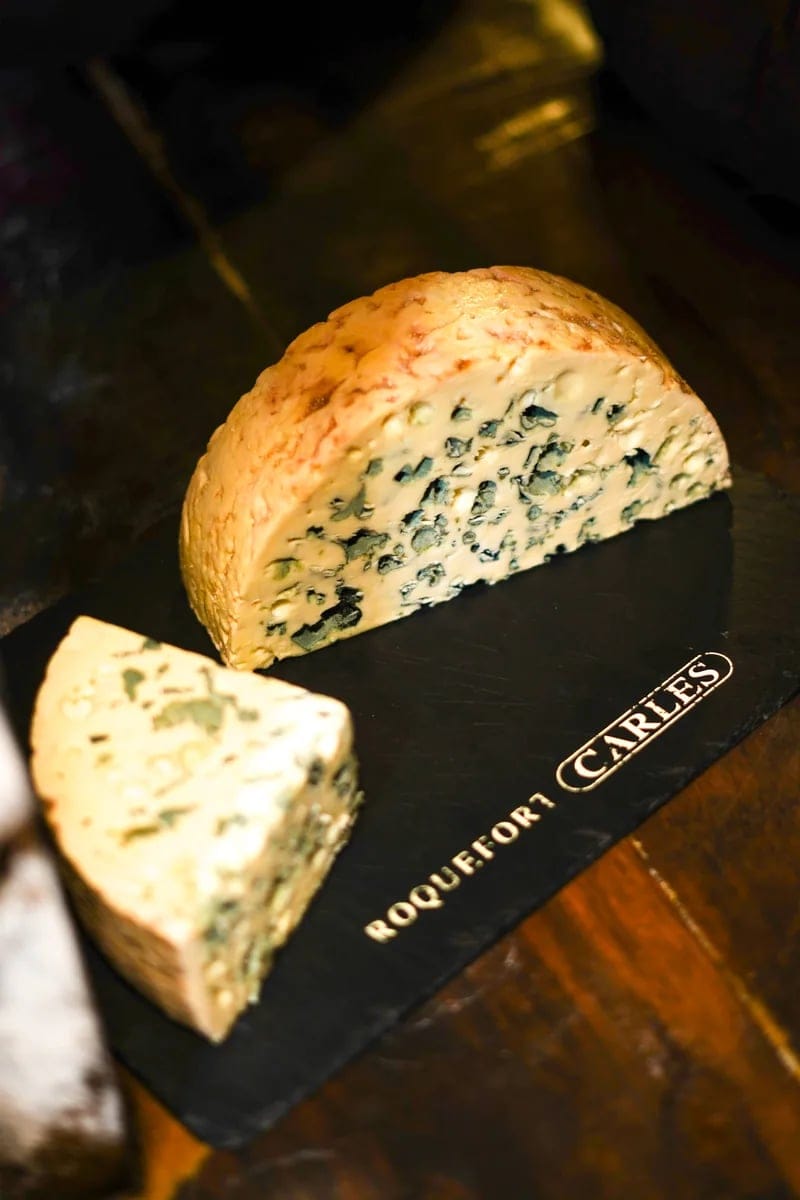
Cheese board arranged around a piece of Roquefort Carles

Composing

Composing a cheese board means imagining a journey for the palate. You start with the most discreet notes and move towards the boldest, alternating textures, letting the aromas answer one another without contradiction. Roquefort Carles, a raw sheep's milk cheese matured on oak in the natural caves of Combalou, naturally takes its place as the crowning note in this progression.

The principle is simple: variety of families, variety of milks, variety of intensities. A soft cheese for mildness, a pressed cheese for roundness, a characterful tomme for depth, and an AOP Roquefort for the final signature. A few well-chosen pieces are always worth more than a scattered assortment.

A successful board reads like a story: it has a beginning, a middle, an end — and Roquefort is its final sentence.Maison Carles, since 1927

Chapter II

Choosing the cheeses
that accompany the Roquefort

§ 02 · Chapter TwoThe selection

First reading

The classic board

Five to seven pieces for a family meal

Soft cheese with a bloomy rind

i.
  • camembert
  • brie
  • chaource

These mild cheeses open the tasting and prepare the palate for the more pronounced notes to come.

Uncooked pressed cheese

ii.
  • tomme
  • saint-nectaire
  • cantal

A milky roundness, a distinct texture: they settle in as the heart of the board.

Aged goat cheese

iii.
  • crottin
  • sainte-maure
  • pélardon

The goat cheese brings a bright, tangy note that prepares the transition to the blue.

Roquefort to finish

iv.
  • Convoitise
  • Élégance

Placed at the edge, cut with a clean blade, the Roquefort Carles brings the tasting to its close.

Second reading

The board built around Roquefort

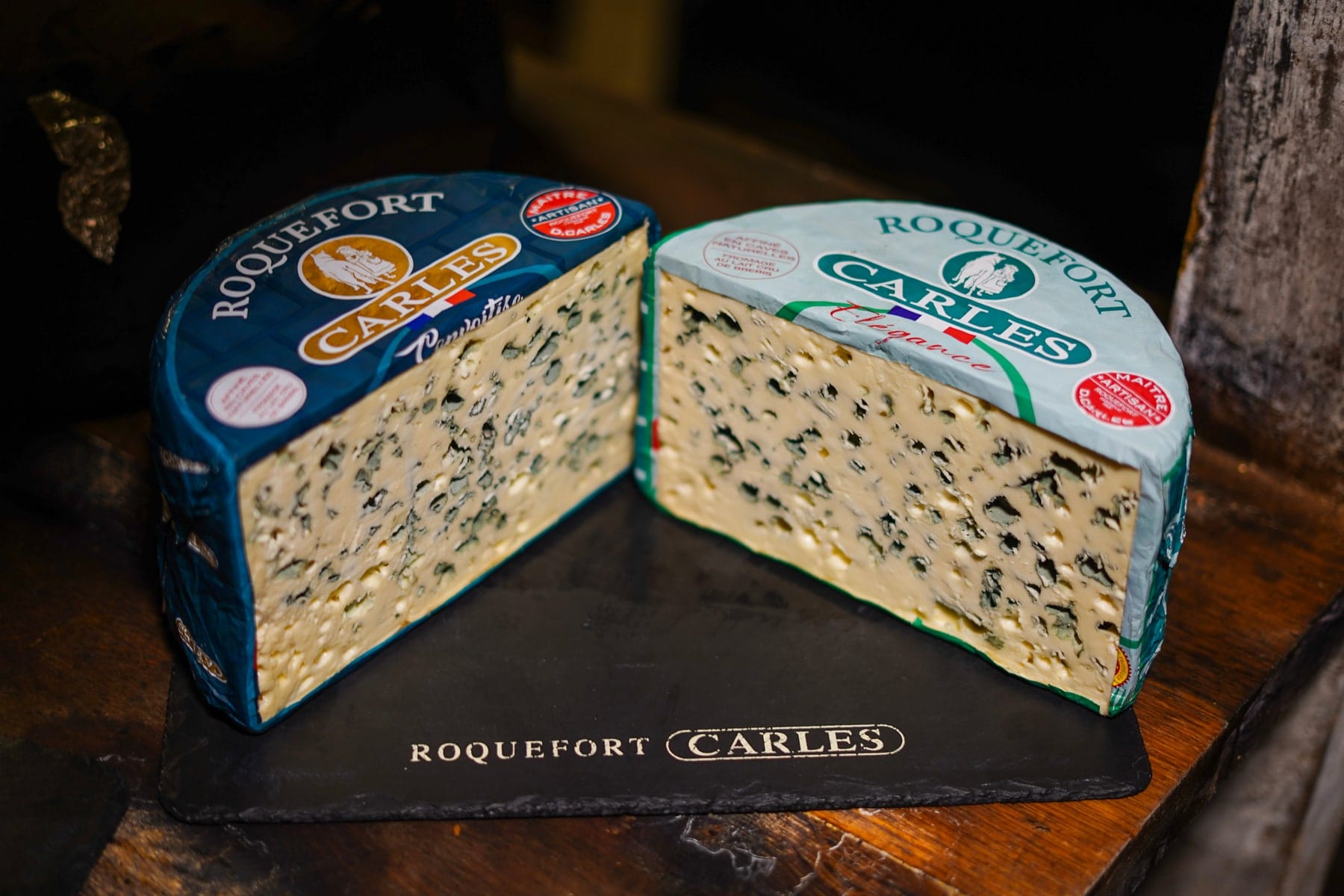
A themed tasting between Convoitise and Élégance

The heart, Convoitise range

i.
  • Roquefort tradition
  • oak

The traditional reference from the Carles house, forthright and full of character.

The echo, Élégance range

ii.
  • Roquefort premium
  • melting texture

A creamier reading, one that converses with Convoitise without repeating it.

The breads

iii.
  • sourdough bread
  • walnut bread
  • fig bread

Three breads for three readings of the same piece, from the most rustic to the sweetest.

The companions

iv.
  • pear
  • fresh fig
  • walnuts
  • mild honey

The sweetness and crunch complement the Roquefort and soften its strength.

Two readings, one shared demand: giving the Roquefort Carles room to fully express itself.

Chapter III

Plating, arranging, presenting

§ 03 · Chapter ThreeThe arrangement

Once the selection is settled, the art of composing a cheese board comes down to a few simple gestures: choosing a neutral surface, organising the order in which it's read, and respecting the distance between pieces so the aromas don't mix.

The surface

Choose a light wood board, a dark slate, or a large ceramic platter. The surface should let each cheese breathe and offer a clear read of its colours.

Avoid bare metal, which can react with the rinds of the moistest cheeses, and always favour a stable surface for cutting.

The reading order

Arrange the cheeses clockwise, from mildest to most powerful. Roquefort, last in the round, signals to guests that the tasting is drawing to a close and invites them to take their time.

A small handwritten label, or a simple wooden cheese marker, lets everyone find their way without hesitation.

The knives

Plan for at least two knives: one for the soft cheeses, another with a thin blade for the Roquefort. Mixing blades means mixing aromas, and each cheese would lose its distinct character.

For the Roquefort, a very clean-edged blade guarantees a neat cut that respects its blue-veined paste.

The temperature

Take the cheeses out thirty to forty-five minutes before serving. Cold dulls the aromas; open air wakes them up. For the Roquefort Carles, this resting time is essential to the expression of its house Penicillium roqueforti.

That said, don't set the board out several hours in advance: the rind dries out and the paste loses its softness.

Arranging a cheese board is a way of honouring the work of the cheese-agers, giving each piece the conditions to fully express itself.

Chapter IV

Bread, fruit and wine
to accompany the Roquefort

§ 04 · Chapter FourThe pairings

Folio I,

Breads and crusts

Bread, the first pairing of the board

Choosing the right bread to accompany a cheese board matters almost as much as choosing the cheeses themselves.

Key points

  • a country sourdough loaf
  • a walnut bread for roundness
  • a fig bread for sweet-and-savoury balance
  • rye bread for character

The technique

  1. Slice the bread into thin strips
  2. Serve it separately, in a warm basket
  3. Save the fig bread for the Roquefort
  4. Let each guest build their own bite

A dense crumb and a robust sourdough support the Roquefort Carles without masking its cave notes.

Sourdough bread and a piece of Roquefort

Folio II,

Fruits and sweet touches

The sweet-and-savoury bridge

A few well-chosen fruits are enough to open up the board and bring together the strongest and mildest cheeses.

Key points

  • ripe pear, sliced at the last minute
  • fresh fig, opened into quarters
  • well-chilled black grapes
  • a few walnut halves
  • a drizzle of acacia or chestnut honey

The technique

  1. Arrange the fruit away from the cheeses
  2. Cut the pear at the last moment
  3. Serve the honey in a small ramekin
  4. Let the table speak for itself

Pear and fresh fig have long signed the finest pairings with a raw milk Roquefort.

Folio III,

Wines and pairings

The glass that closes the tasting

The choice of wine is the final touch: it extends the reading of the board and gives the Roquefort its final resonance.

Key points

  • a sweet dessert wine for the Convoitise range
  • a naturally sweet fortified wine for the Élégance range
  • a tannic red wine for the pressed cheeses
  • a glass of water between each pairing

The technique

  1. Serve the wine lightly chilled
  2. Taste the cheese on its own first
  3. Then take a sip of wine
  4. Notice how the aromas unfold

To go further, see our page dedicated to wine and Roquefort pairings, which details the meeting between our two ranges and the great dessert wines.

Glass of dessert wine and a piece of Roquefort on a board

Further reading

To explore the board further

Composing a cheese board is a tribute to a terroir. Each piece tells the story of the cave that saw it born, the hand that shaped it, the time that made it what it is.

More to read on the site

To better understand the signature of Roquefort Carles on a board, explore our page on how to taste Roquefort, discover the work of the Combalou caves, and explore our two ranges, Convoitise for its tonic character and the Élégance range for its melting roundness. For the glass, our Roquefort wine pairings page continues the story. For the big end-of-year celebrations, you'll also find our tips for putting together a holiday board worthy of the moments that matter.

Combalou Caves, Roquefort-sur-Soulzon, Aveyron

Frequently asked questions

Composing a cheese board: your questions

§ 05 · Chapter FiveFAQ

How many cheeses should you plan for a well-balanced cheese board?

For an end-of-meal board, the classic rule of thumb is five to seven cheeses from different families, with a portion of around thirty to fifty grams per guest per cheese. The idea is less about quantity than diversity: if you're serving a Roquefort Carles matured on oak, pair it with milder cheeses so its strength doesn't overpower the tasting.

Where should Roquefort be placed on a cheese board?

Roquefort, a cheese of real character, is always tasted last, just before the milder or sweeter notes. On the board, place it around the edge to stop its aromas migrating towards the more delicate cheeses. A clean blade to cut it, a visual marker for guests, and the end of the meal finds its crowning moment.

How can you combine the Convoitise and Élégance ranges on the same board?

The two Carles ranges tell two different stories of Roquefort. Convoitise brings the tonic, forthright character of the traditional cheese; Élégance offers a more melting, creamier reading. On a cheese board, you can present both side by side in small portions, with a simple card explaining the difference — your guests can then run their own side-by-side tasting.

What breads and fruits should you serve alongside a cheese board with Roquefort?

Choose a country sourdough loaf, a walnut bread or a fig bread that stands up to the strength of the Roquefort without overwhelming it. For fruit, pear, fresh fig and black grapes build a natural sweet-and-savoury bridge. A few walnut halves, a drizzle of mild honey, and the board gains real depth.

Should cheeses be brought to room temperature before serving?

Yes — all cheeses, and Roquefort even more so, reveal their aromas at room temperature. Take your Roquefort Carles out of its wrapping thirty to forty-five minutes before serving, somewhere cool but not cold. The paste relaxes, the house Penicillium roqueforti releases its notes, and the tasting takes on a whole new dimension.

Can a cheese board be built entirely around Roquefort?

It's an elegant option for a themed dinner: presenting several expressions of the same cheese. You can bring together the two Carles ranges, Convoitise and Élégance, alongside a variety of breads, a drizzle of honey and a few dried fruits. The exercise highlights the work of the family house and the richness of an AOP Roquefort made entirely by hand.

To deepen your discovery of Roquefort Carles, you can also consult the encyclopedia entry Roquefort on Wikipedia, which traces the history and specifications of the appellation.

A cheese board with the signature of a family house

Since 1927, the house of Roquefort Carles has passed down the very same craft: a raw sheep's milk Roquefort made entirely by hand, seeded with a house-cultivated Penicillium roqueforti grown on bread — the Amandine and Maxime strains — and matured on oak boards in the natural caves of Combalou. Building a cheese board around our Roquefort means inviting three generations of cheese-agers to your table, along with the commitment of thirteen partner farms that deliver milk the very same day it's milked.

The art of composing a cheese board hasn't changed in a long time: finding the balance between the different pastes, carefully building up the progression of intensities, choosing breads and fruits that converse with the cheeses rather than covering them up. Our Roquefort, an AOP cheese from the Roquefort-sur-Soulzon terroir in the Aveyron, finds its natural place at the end of the tasting, where it can show the full measure of its character and its history. Whether you're hosting family, preparing a dinner for discerning guests, or simply want to offer a moment of epicurean pleasure, the cheese board remains one of the finest ways to extend a meal.

The two readings of our Roquefort, the Convoitise range and the Élégance range, give you two ways to sign a cheese board. Convoitise brings the tonic, forthright character of a traditional Roquefort, cut for lovers of strong flavour and long finish. Élégance unfolds a more melting, creamier reading, one that wins over seasoned palates and newcomers to Roquefort alike. Presented side by side, they tell the richness of the same family know-how declined into two signatures, under the historic emblem of the Chaperon Rouge.

To the table

Put together your cheese board with a Roquefort Carles

Have our Convoitise and Élégance ranges delivered to your door, or write to us for a made-to-measure board project — receptions, private dinners, chef's tables.