Maison Carles, since 1927
High-end Roquefort
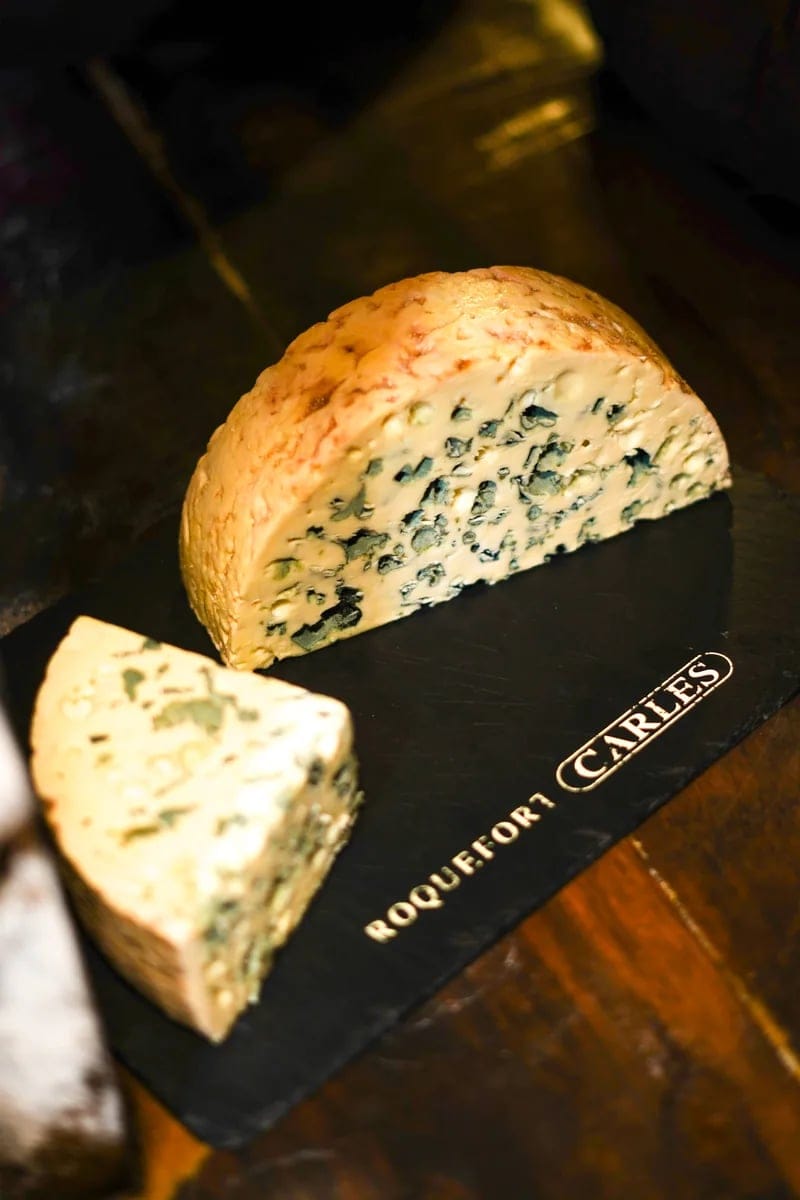
A high-end Roquefort crafted by hand, made with raw sheep's milk, and aged on oak boards in the natural caves of the Combalou.
Maison Carles, since 1927
A high-end Roquefort crafted by hand, made with raw sheep's milk, and aged on oak boards in the natural caves of the Combalou.
Chapter I

Today's milk, delivered by the house's partner shepherds.
Talking about high-end Roquefort isn't about waving a marketing label. It means describing a precise way of making, ageing and respecting the cheese's long, slow time.
At Maison Carles, three concrete elements set this standard. The first is the milk: whole, raw, delivered by sheep fed as close as possible to their mountain pastures, and worked the very day it is milked. The second is the Penicillium roqueforti, cultivated on site on bread rather than bought ready-made. The third is the cave: a natural site, the Combalou, ventilated by fleurines, where the wheels rest on oak boards.
Each of these choices costs more time, attention and manual effort than standard production. They are not optional for a high-end Roquefort: they are its condition.
No label can replace this workshop reality. When you hold a wheel from the house in your hands, you are holding a cheese that has been turned, salted, pierced, watched, moved. Not a product loaded onto a pallet and then forgotten in a cold store.
Here, the high end
is measured in hours spent in the cave, not in logos.
Chapter II
A high-end Roquefort begins with its raw materials. Without quality raw milk and a strain of its own, no amount of ageing, however long, could make up for a poor start.

The milk
Thirteen partner farms, delivered the same day
The house works with thirteen partner farms, located within the appellation area. The milk arrives raw, unstandardised, still warm from the morning. This freshness changes everything: the milk's natural cultures are preserved, and the living flora of a high-end Roquefort takes hold from the moment the rennet is added.
The culture
Amandine and Maxime strains, cultivated on bread
The Penicillium roqueforti used by the house is not bought freeze-dried. It is cultivated on site, on bread, using a patient method passed down from generation to generation. Two strains shape the bouquet: Amandine, soft and fruity, and Maxime, more distinctive. This culture work is an integral part of what is expected of a high-end Roquefort.
Chapter III
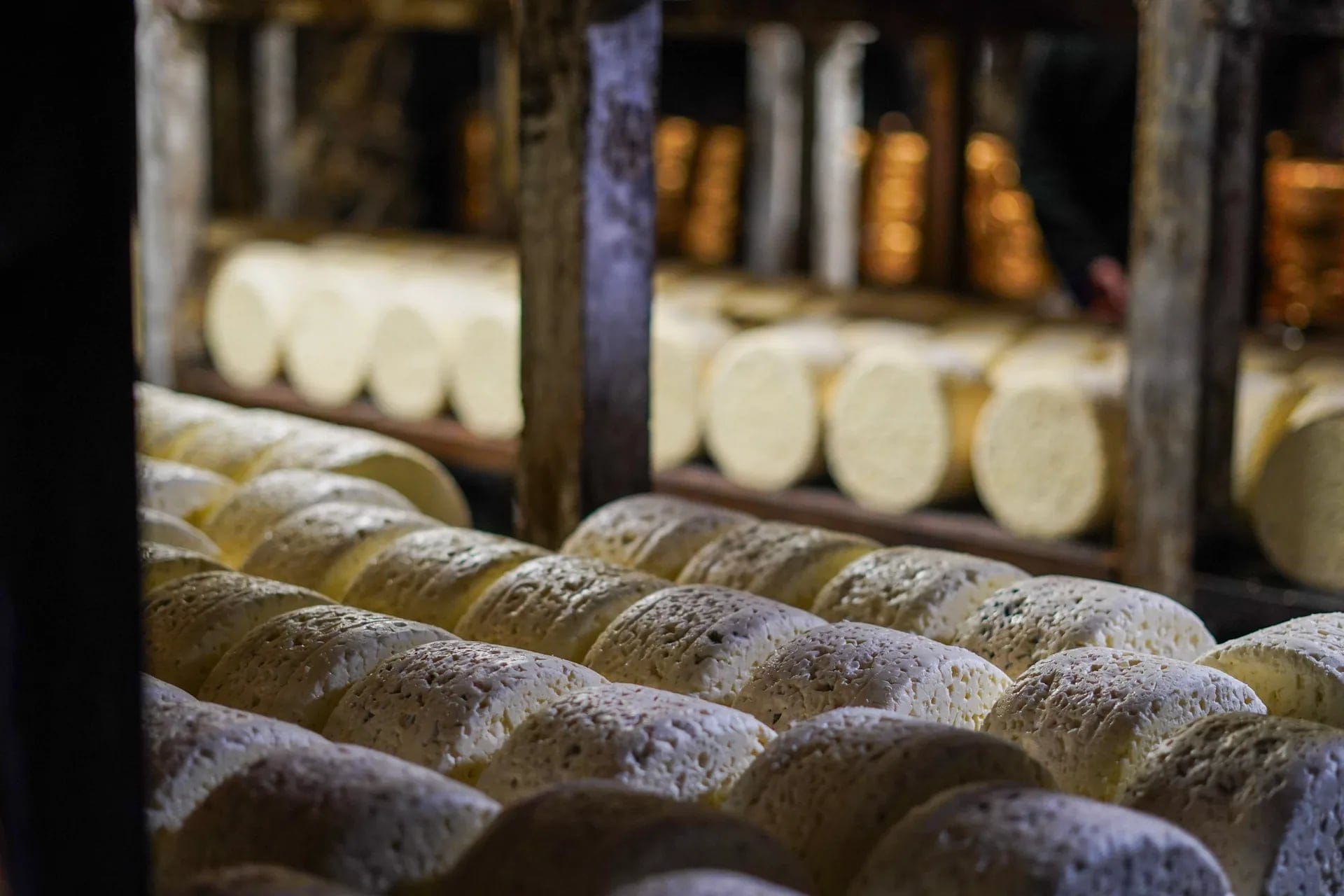
A high-end Roquefort is not made in a stainless-steel chamber. It is built in a natural cave, on wood that breathes. At Maison Carles, ageing takes place in the caves of the Combalou, ventilated by the fleurines.
The cave
The caves of the Combalou are the natural birthplace of Roquefort. The house has worked there since 1927, in a rare family continuity.
Microclimate
The fleurines, natural fissures in the rock, circulate a constant flow of air that regulates the cave's temperature and humidity without any mechanical intervention. It is this underground breathing that sets a high-end Roquefort apart from a simply refrigerated cheese.
Three generations
Three generations of the Carles family have succeeded one another in the same cave since 1927. This human continuity is part of the signature: the gestures cannot be improvised, they are learned at the side of one's elders.
The wood
Oak accompanies the blue paste throughout its ageing. A living surface, that interacts with the curd instead of isolating it.
Why oak
The wood absorbs excess moisture, releases what is needed, and lets the rind form at its own pace. This breathing does not happen with a neutral surface. For a high-end Roquefort, it is a decisive detail in the final texture.
Hands-on care
Each wheel is followed individually, turned, watched, and moved according to how it develops. Ageing is never automatic: it is a continuous reading of the cheese's condition by the men and women of the cave.
Chapter IV
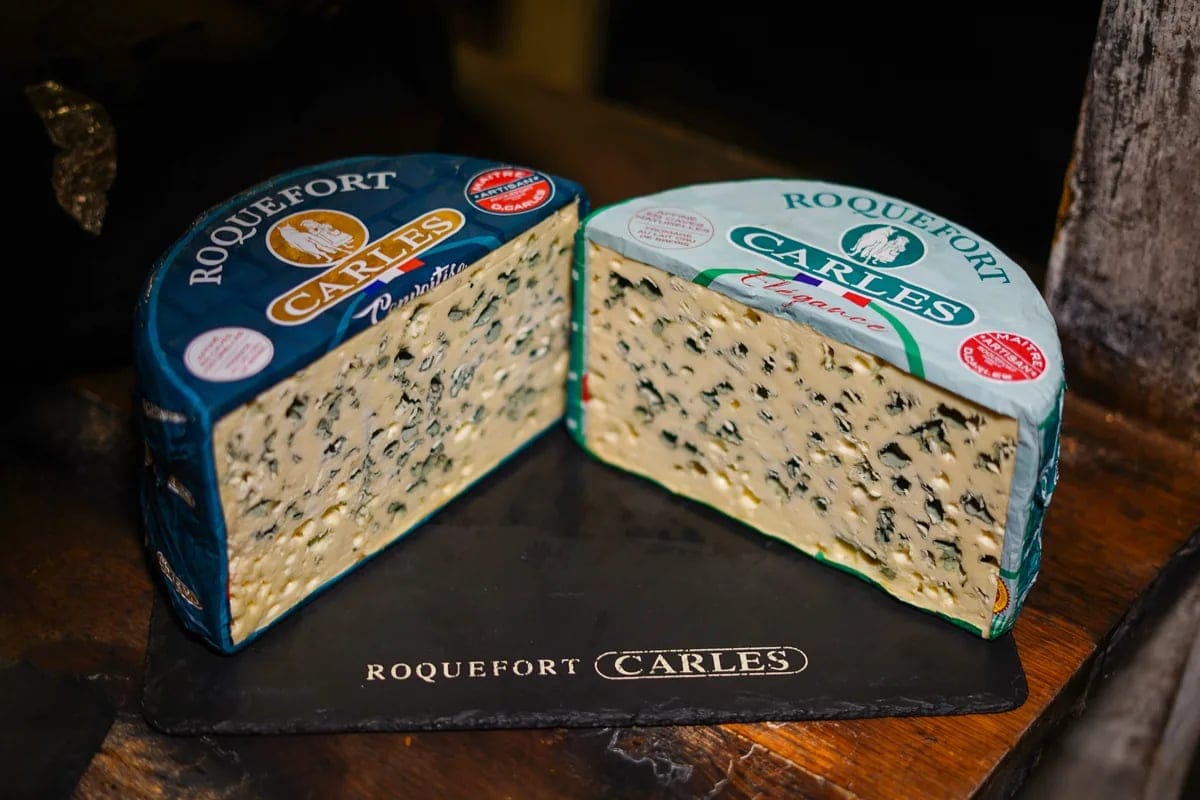
Maison Carles offers two complementary ranges, covering the full register expected of a high-end Roquefort: the bold character of a traditional Roquefort, and the finesse of a more contemporary profile.
Traditional benchmark
The Convoitise range is the house's historic reading of high-end Roquefort. Bold profile, long finish, generous blue paste: this is the Roquefort you picture when you think of artisanal raw-milk Roquefort.
Accessible premium
The Élégance range offers a more delicate approach, designed as a premium entry point. The blue paste is more subtle, the texture creamier, without giving up any of the aromatic signature of a true cave-aged, high-end Roquefort.
Discover the Convoitise range or the Élégance range, and choose the reading that suits you.
Chapter V
A high-end Roquefort is not a mass-market product. It speaks to connoisseurs looking for a genuine signature, and to food professionals who want a cheese equal to their cuisine.
Individuals
For those who like to understand what they are eating, compare profiles, and set a table where Roquefort plays a real role.
At home
A high-end Roquefort anchors a cheese board. Well served, slightly tempered, paired with a rustic bread and a well-chosen glass, it becomes the centre of gravity of the meal rather than a mere side note.
Professionals
The house works with Michelin-starred chefs and demanding restaurateurs who are looking for an artisanal Roquefort with a recognisable profile, capable of defining a dish.
Supply
For restaurants and chefs, the house offers support tailored to their volumes, their cycles and their menus. A high-end Roquefort follows the rhythm of the kitchen, not the other way around.
Chapter VI
A high-end Roquefort is recognised by the quality of its milk, the origin of its Penicillium, and the care taken in its ageing. At Roquefort Carles, all three criteria come together: raw sheep's milk collected from thirteen partner farms, Penicillium roqueforti cultivated in-house on bread, and traditional ageing carried out on oak boards in the natural caves of the Combalou.
The Convoitise range is the house's traditional benchmark, true to the bold, lingering character of a well-aged Roquefort. The Élégance range offers a more delicate profile, designed as a premium entry point for discovering high-end Roquefort without losing its aromatic signature.
Oak breathes with the cheese, regulating humidity in contact with the curd and giving the blue paste time to develop its aromas. This traditional practice, still upheld at Maison Carles, gives high-end Roquefort a melting texture and a length on the palate that inert surfaces cannot reproduce.
Yes. Maison Carles' high-end Roquefort is made entirely by hand, gesture after gesture, just as it was on the first day of the family business founded in 1927. Three generations have succeeded one another in the same cave, without ever breaking the chain of transmitted know-how.
You can order directly from the house's online shop, or come and choose your wheels at the cave, avenue de Lauras in Roquefort-sur-Soulzon. Restaurateurs and Michelin-starred chefs also have dedicated access for their professional supplies.
It's an essential aromatic signature. Maison Carles cultivates its own strains on bread, named Amandine and Maxime, which give high-end Roquefort a recognisable identity, distinct from the standardised cultures used elsewhere in the appellation.
Time to taste
Whether you are preparing an exceptional cheese board or looking for a trusted supplier for your restaurant, the house is here to help. Choose your range, ask for advice, or come through the door of the shop on avenue de Lauras.
To go further, also explore our cheese-making and ageing process, the caves of the Combalou, our approach to raw-milk Roquefort, or what makes a true artisanal Roquefort.