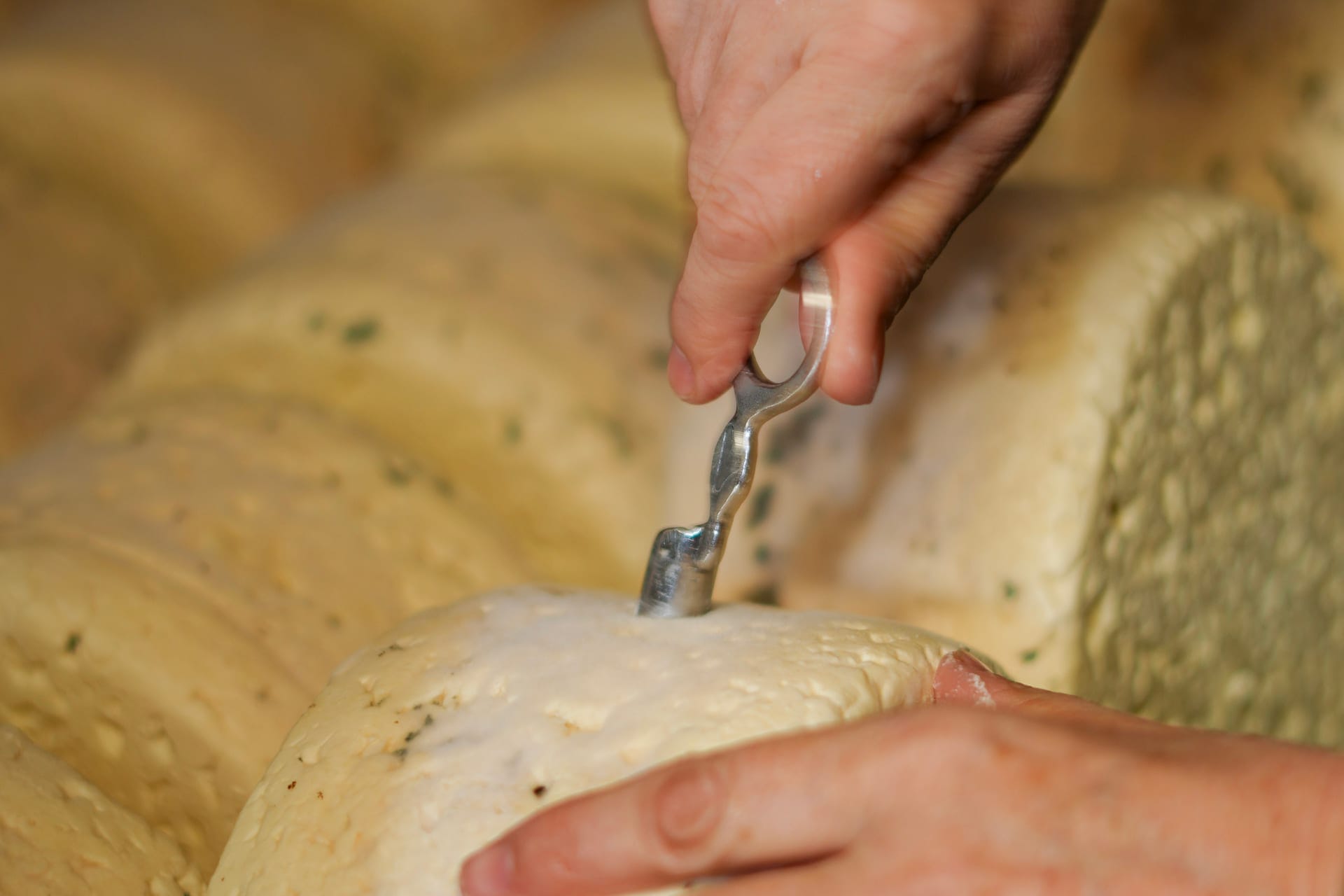
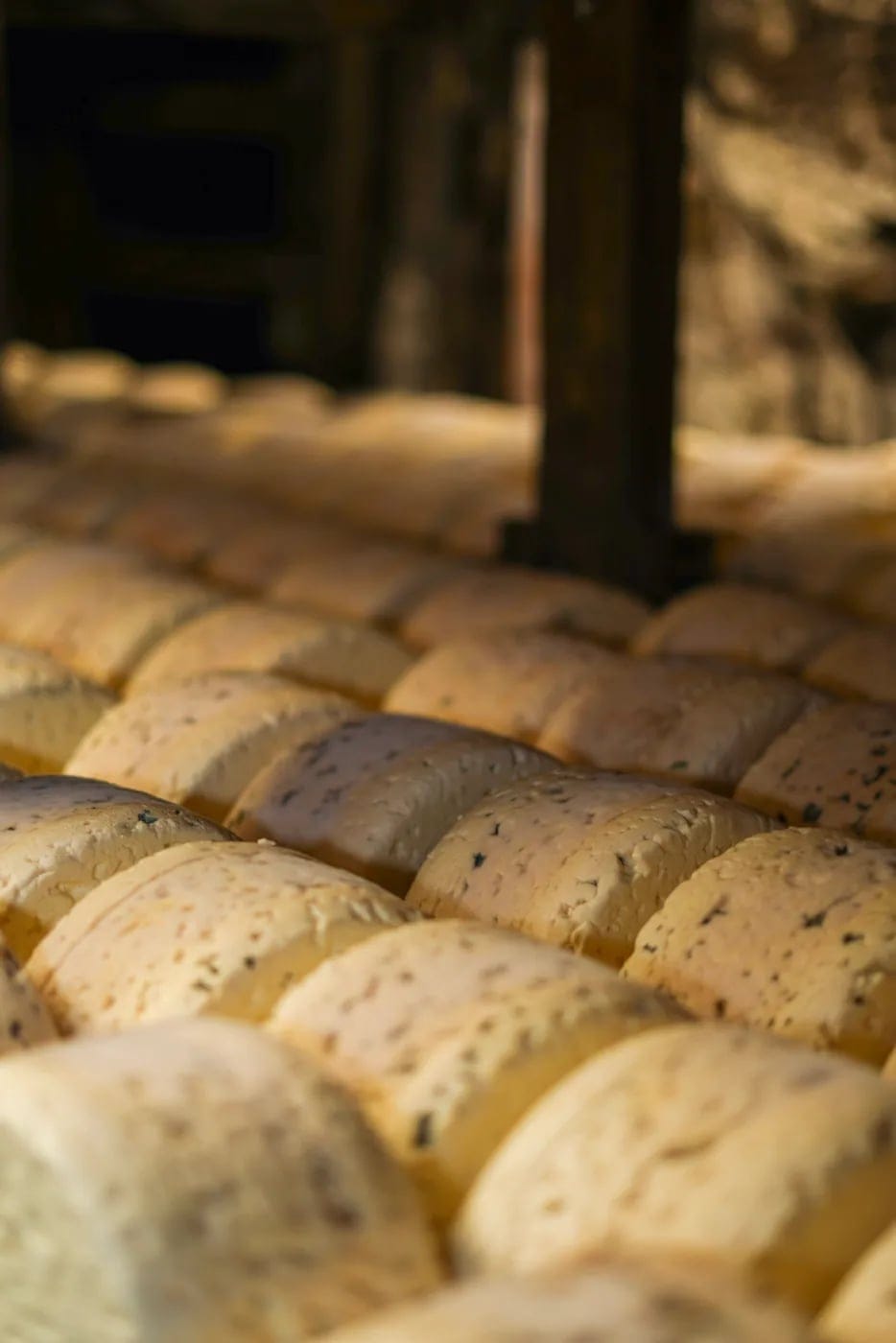
Ageing lasts at least three months for AOP Roquefort, until the cheese asks to come out. The cheeses are turned regularly, by hand, moved on the boards according to their progress. No automatic schedule. Each piece is given the time it claims.
The oak travée is not an aesthetic choice. Stainless-steel boards, widely adopted by the industry, are easier to wash and quicker to maintain. They are also neutral, so they transmit nothing. Wood, on the other hand, carries a house microflora that takes part in the signature of Roquefort Carles. To remove it would be to lose part of what makes the taste.
The caves of Combalou
The caves are a natural geological fault, carved millennia ago into the Combalou Rock. Fissures in the rock, the fleurines, constantly ventilate the galleries. The air that flows through comes from the mountain. It is cold, humid, regulated. The temperature holds between 7 and 10 degrees, humidity near 95%, year-round, without any human adjustment.
It is in these conditions that Roquefort invented itself, several centuries ago. No artificial cave, however efficient, exactly reproduces that blend of stability and breath. The affineurs who descend into these caves walk through a current of air that has never changed.
The cheese is watched, turned, moved. It is not rushed. When it is ready, it says so: the colour of its rind, the firmness of its paste, the spread of its blue. The affineur has been reading those signs for a lifetime. It is the last gesture of the crafting, and the longest.
L’affinage traditionnel se déploie dans les caves du Combalou sur des travées en chêne séculaires. Ces caves naturelles du Combalou, traversées par les fleurines, maintiennent naturellement la température et l’humidité requises tout au long du cycle. La durée exacte, autrement dit combien de temps d’affinage est nécessaire, dépend de chaque meule et de la saison.
Au-dessus des caves, le plateau calcaire qui domine le village et les vastes étendues du Larzac nourrissent les troupeaux dont nous tirons cette tradition aveyronnaise du lait de brebis. Une fois la meule prête, elle révèle toute sa profondeur dans nos alliances avec les grands vins doux ou, plus simplement, autour d'une assiette de noix et bleu pour une dégustation sans détour. Du lait à la meule, tous ces gestes se tiennent au même endroit : notre fromagerie de Roquefort, à Roquefort-sur-Soulzon.