Penicillium roqueforti: the mould that gives Roquefort its soul
Without it, Roquefort would be just an ewe’s-milk cheese. Penicillium roqueforti is the microscopic mould that draws the blue-green veins and shapes the aromas. At Carles it is not bought in a bottle: it has been grown in-house, on rye bread, since 1927.
The essentials
Penicillium roqueforti, in short
Penicillium roqueforti is a microscopic mould found naturally in the Combalou cellars. Once the curd is seeded and needled to let air in, it develops the blue-green marbling and powerful aromas of Roquefort. Maison Carles grows its own strain on rye bread rather than buying an industrial ferment, selecting two house lines — Amandine and Maxime — that sign its Convoitise and Élégance ranges. Eaten in a ripened cheese, this mould is a fully controlled food mould, and safe.
Contents
Contents
Chapter I · Biology
What is Penicillium roqueforti?
§ 01 · The mouldA noble mould
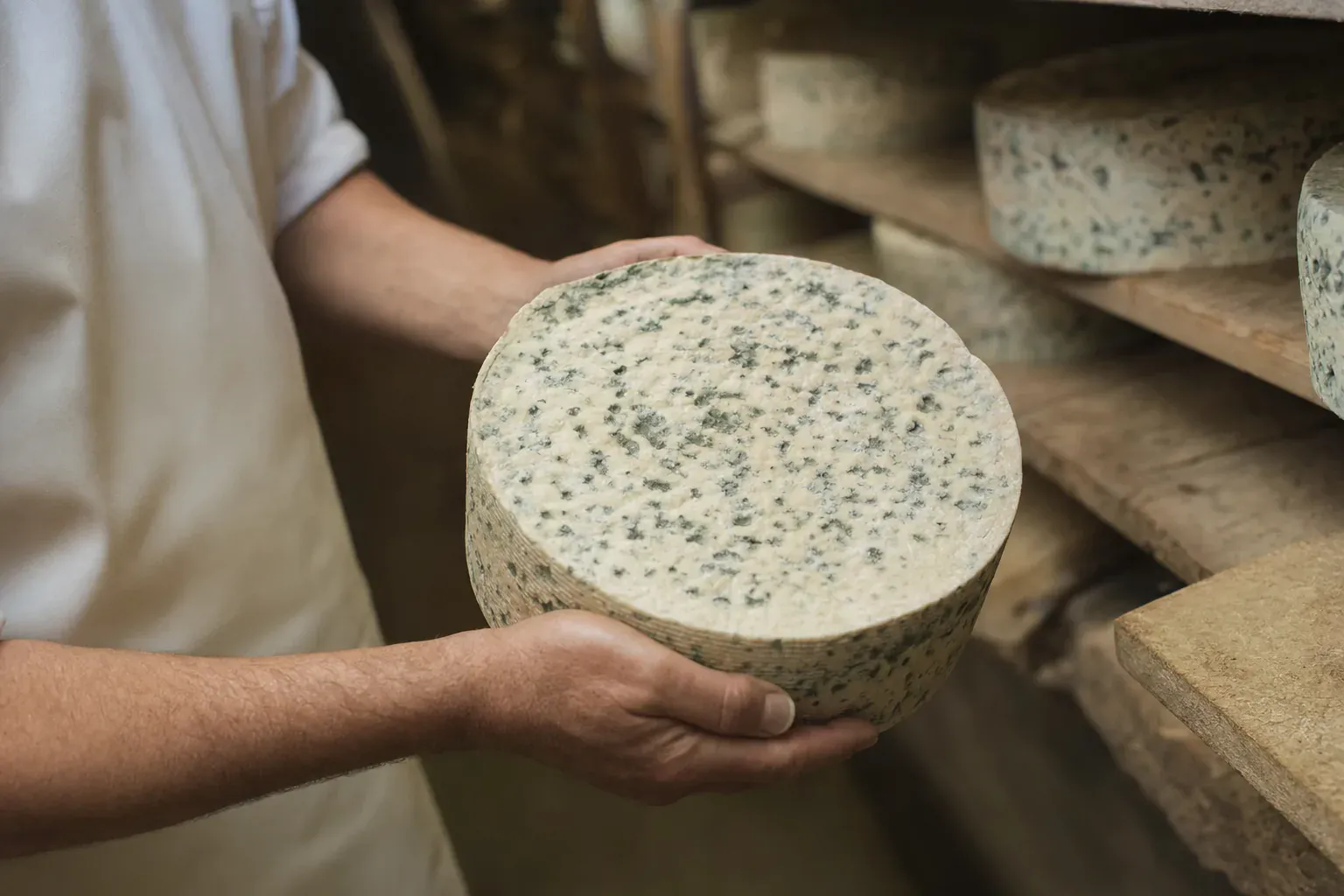
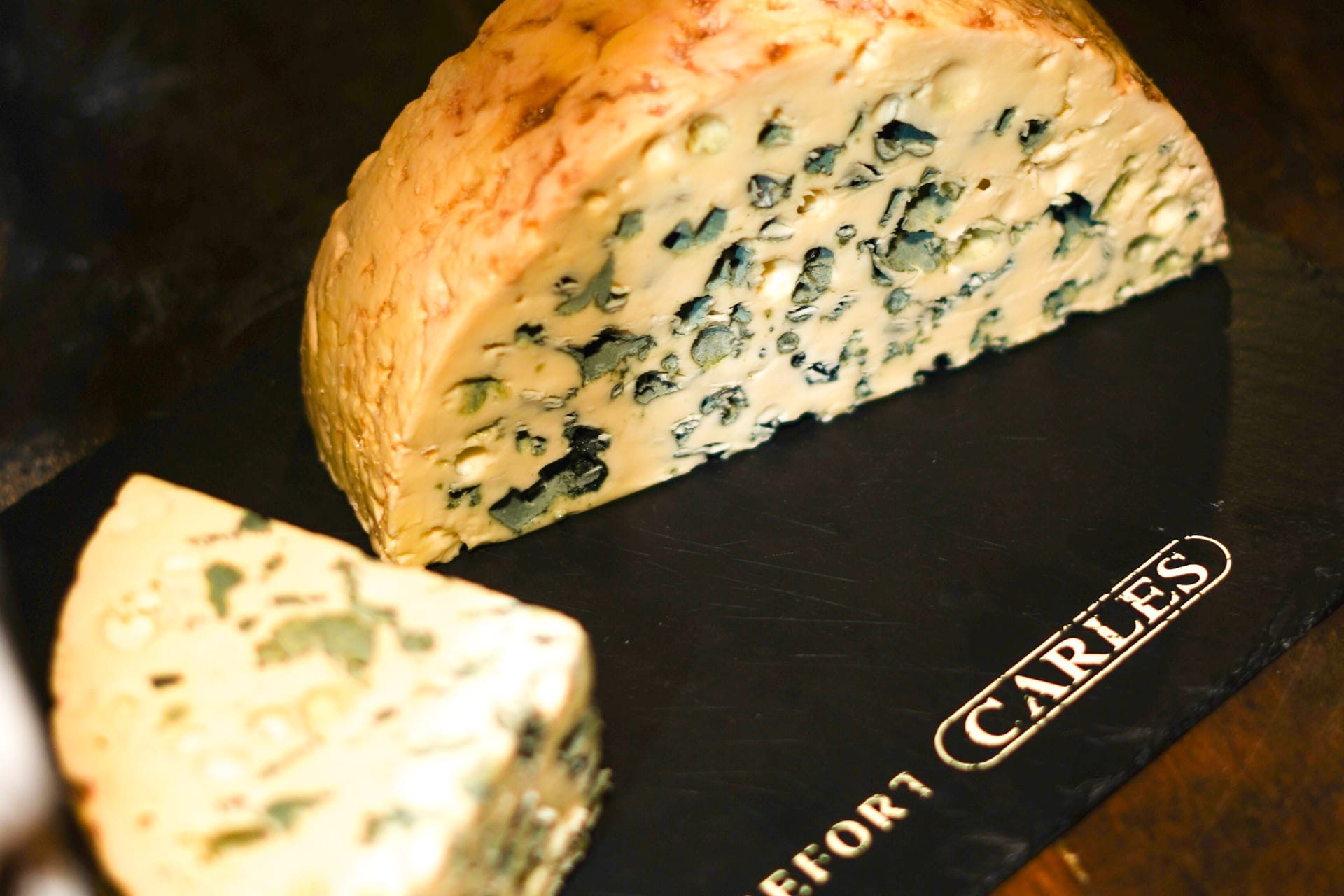
Penicillium roqueforti is a microscopic mould. It belongs to the same genus as Fleming’s penicillin, but the Roquefort strain has been domesticated for centuries by Aveyron cheesemakers. It alone turns white ewe’s-milk paste into a blue-veined cheese known worldwide.
A noble mould, not a defect
In most foods, mould means throw it away. Penicillium roqueforti is the exception: a sought-after, cultivated mould that reveals rather than spoils the cheese — a “noble” mould, like the bloom on a camembert.
We wrongly link blue-green to rot; here, the marbling proves a healthy, controlled fermentation.
Where it lives: the Combalou cellars and the fleurines
The mould lives naturally in soils and, above all, in the natural Combalou cellars at Roquefort-sur-Soulzon, crossed by the fleurines — rock faults bringing constant cool, humid air.
That stable, humid climate let the mould settle into the rock. Legend tells of a shepherd’s forgotten bread and cheese found blue-veined — behind the myth, the Combalou is the mould’s natural home.
Its role: blue-green marbling and aromas
The mould both colours — forming the blue-green veins — and, crucially, transforms flavour, releasing woodland, buttery and piquant notes as it digests the milk’s fats and proteins.
Without it, the cheese would stay mild and flat. It gives Roquefort its soul.
From spore to cheese: how the mould works the paste
§ 02 · The craftThree key steps
Following the cheese means following the mould, from spore to ripened wheel. The process comes down to three decisive steps, each letting the mould work without being forced.
I
Seeding the curd
As the raw ewe’s milk curdles, spores of Penicillium roqueforti are introduced. The mould is present everywhere but dormant — it lacks oxygen. The curd is moulded, drained and salted while the mould waits.
II
Needling and the oxygen that wakes the blue
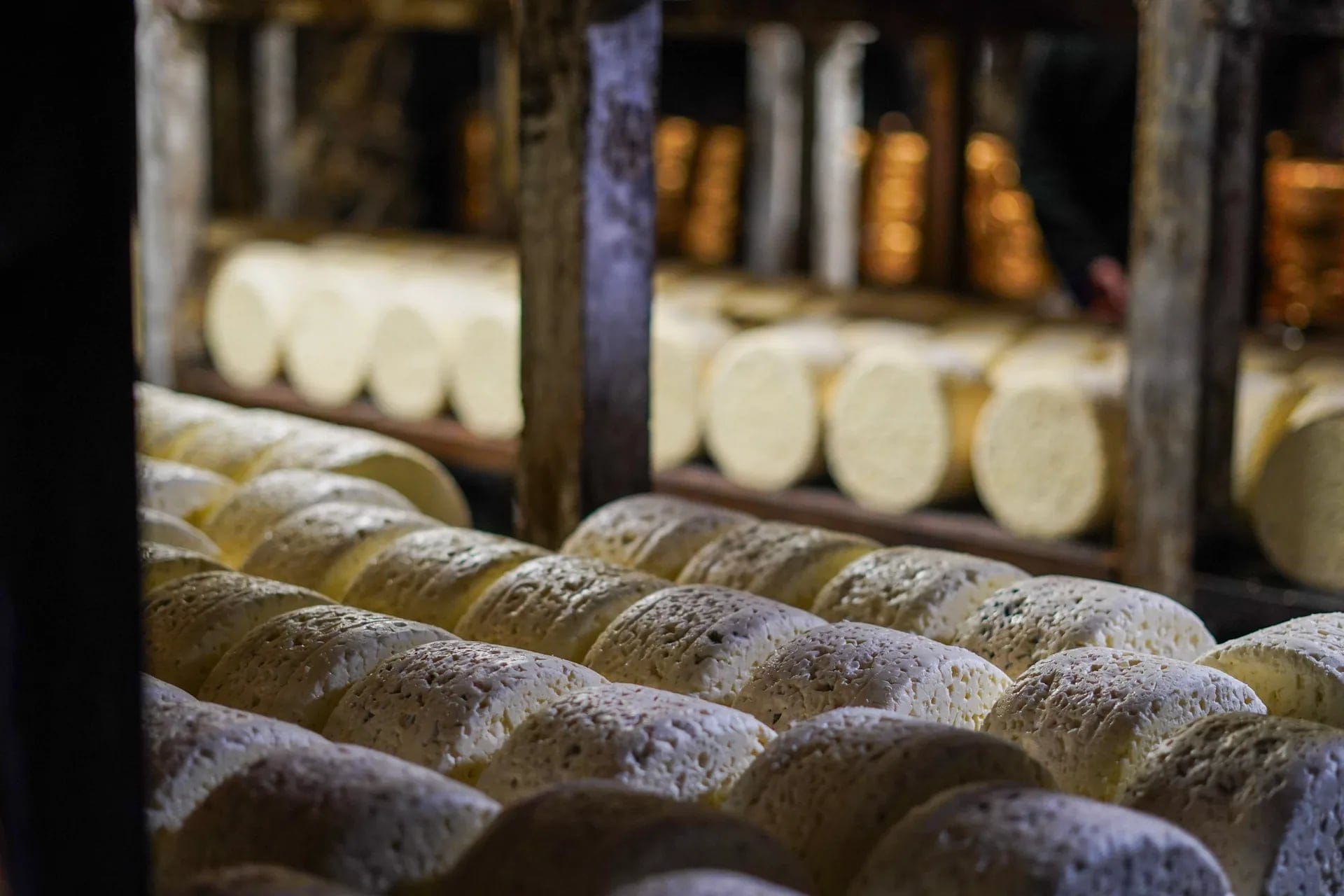
Each loaf is pierced with long needles, opening dozens of vertical chimneys. Air rushes in, and the aerobic mould wakes and grows along them. The blue is born precisely there — in the needled cavities, nowhere else.
III
Proteolysis and lipolysis: creamy and piquant
The mould secretes enzymes: some break down proteins for a softer paste, others break down fats to release piquant, lasting compounds. Roquefort’s creaminess and bite are not added — they are made, molecule by molecule.
This unfolds slowly, through the making steps and the ripening time of each wheel. The cheesemaker imposes nothing: he sets the conditions, and the mould does the rest.
« We do not make the blue. We invite the mould to make it. »
Maison Carles, family spirit
Chapter III · Know-how
The Carles choice: growing its own Penicillium on bread
§ 03 · The houseA living strain
Almost every Roquefort maker now buys standardised industrial strains in a bottle. Since 1927, Maison Carles has done the opposite: it grows its own mould. On bread.
Why grow in-house rather than buy an industrial strain
A house strain is not nostalgia. Industrial strains are neutral and uniform; a house strain carries the print of the cellar, the hand and the bread it grows on, giving a cheese like no other.
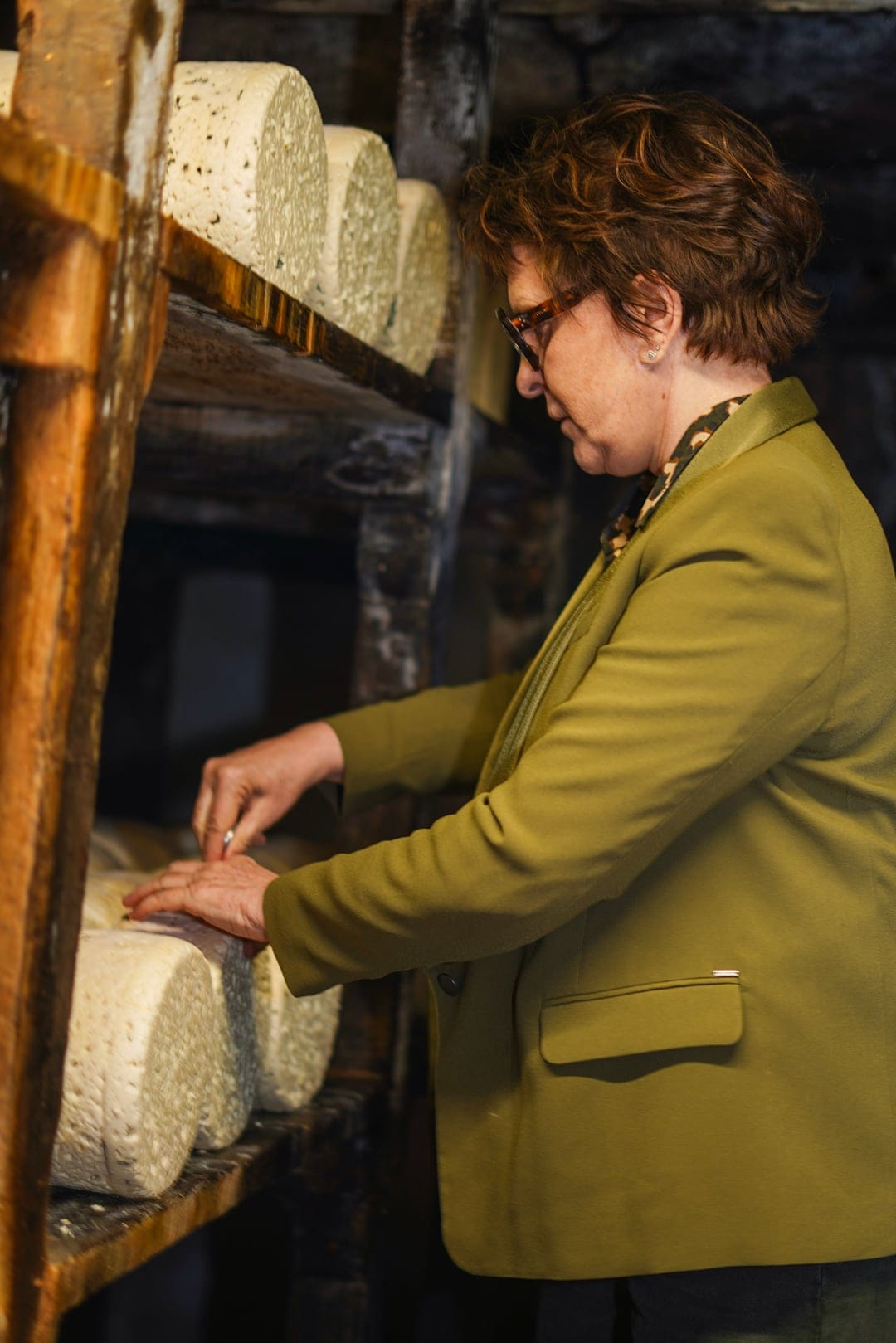
Rye loaves are left in the Combalou cellars; the airborne mould covers the crumb, then the bread is dried, ground and used to seed the raw-milk vats — an unbroken living chain, like a sourdough, for nearly a century.
This daily intimacy with the mould, more than any recipe, defines the house style at every step.
Chapter IV · Signature
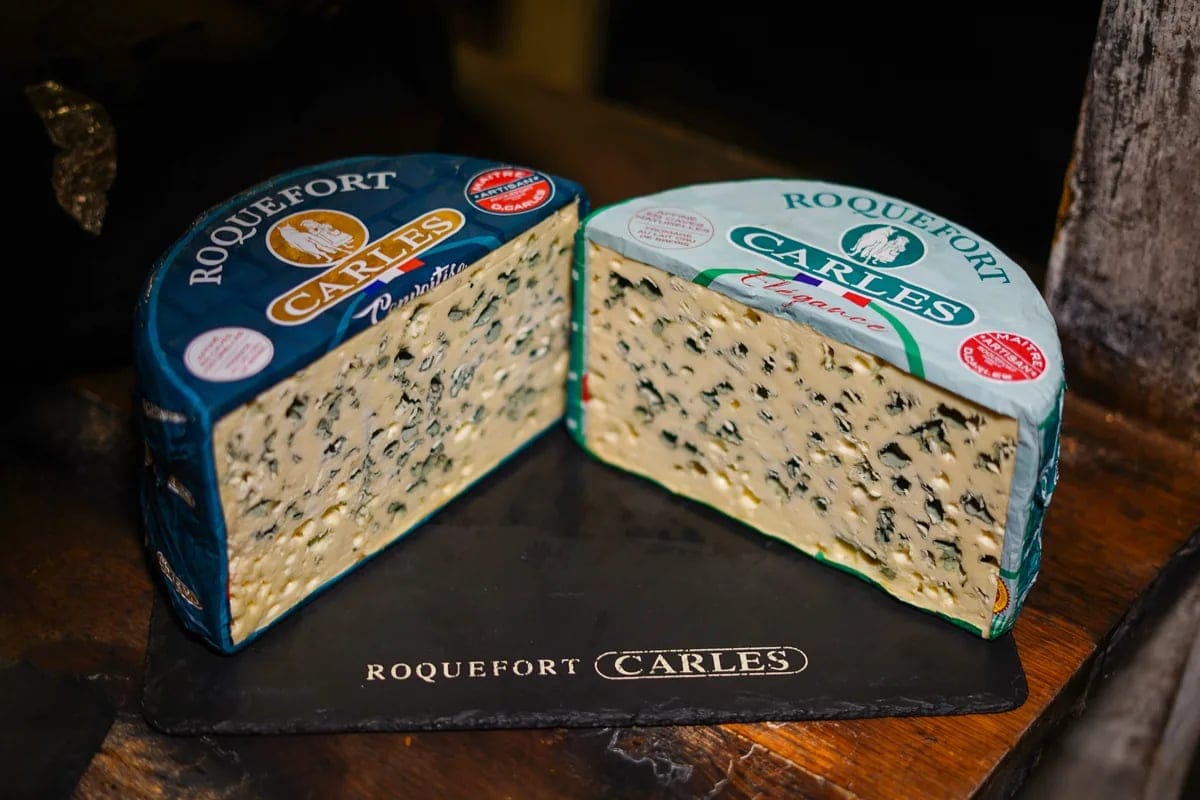
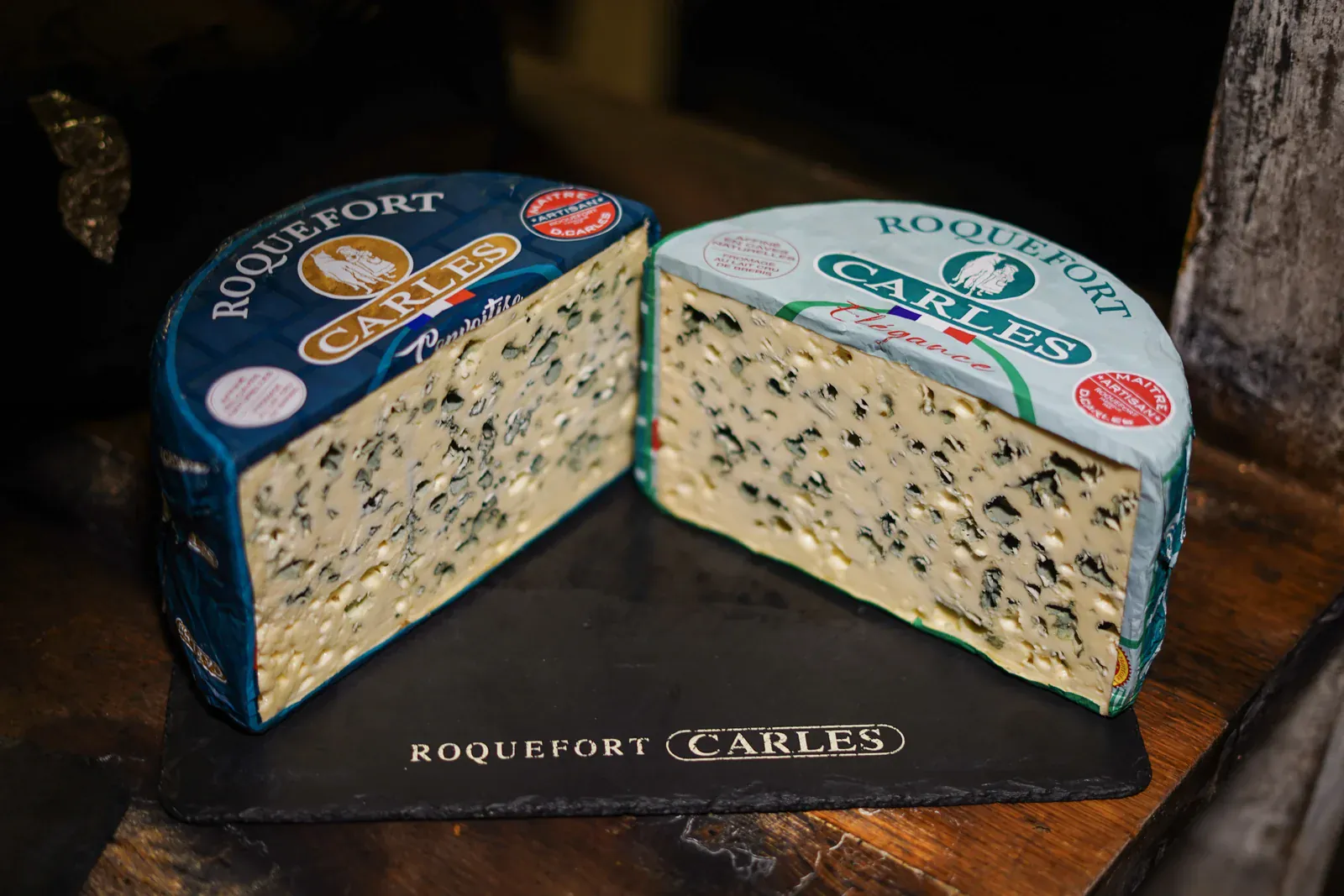
Amandine and Maxime: two strains, two signatures
§ 04 · The strainsConvoitise & Élégance
The house culture yields not one mould but two selected strains, named like family: Amandine, selected by Jacques Carles, and Maxime, selected by Delphine Carles. Two temperaments that shape each range.
Convoitise, the traditional benchmark
Long-rested on oak, it lets the mould speak fully: bold blue, dense paste, powerful length. The house’s historic signature.
Penicillium roqueforti and health: should you worry?
§ 05 · Peace of mindA controlled mould
A mould in a food we eat on purpose can worry people. It shouldn’t.
A controlled food mould
The mould used in cheesemaking is a selected, monitored food mould, unrelated to contamination moulds. In a ripened cheese it is fully digestible and safe for the vast majority of people.
The difference is control: temperature, humidity, time and strain are managed end to end in the cellars.
The raw-milk case
Roquefort Carles is made from raw, unpasteurised ewe’s milk, which preserves the natural microflora the mould needs — and demands higher hygiene at every step.
As with any raw-milk cheese, health authorities advise caution for the most vulnerable — pregnant women, very young children.
Chapter VI · Comparison
Penicillium roqueforti or camemberti?
§ 06 · Two cousinsTwo cheeses
The two noble cheese moulds are often confused: close names, same genus, very different work.
Camemberti grows on the surface, forming the white bloomy rind of camembert and brie; roqueforti works from within, marbling the core through the needled chimneys.
One dresses, the other veins — hence a creamy camembert under its rind versus a Roquefort marbled to the core.
Frequently asked
All about Penicillium roqueforti
Is Penicillium roqueforti dangerous?
No. In a ripened cheese like Roquefort it is a controlled food mould, eaten safely for centuries. It is selected, cultivated and monitored under controlled conditions. Vulnerable people should simply follow the usual raw-milk cheese advice.
Can you grow it at home?
In theory the mould exists in nature; in practice, a stable, safe, tasty strain is a real craft. Maison Carles has grown it on rye bread in the cellar since 1927. Reproducing it at home without control of environment, hygiene and ripening is strongly discouraged.
How does it differ from Penicillium camemberti?
Camemberti forms the white surface rind of camembert and brie; roqueforti develops the blue-green marbling in the core. One works from the outside, the other from within — hence two textures and tastes.
Why does a house strain change the flavour?
A strain is never truly neutral. Industrial strains are standardised for uniformity; a house strain, grown in a specific cellar on specific bread, carries that place’s print. Amandine and Maxime sign aromas a bought ferment cannot copy.
Does needling really matter?
Yes. The mould needs oxygen. Needling opens chimneys, air enters, and the mould grows along them — precisely where, and only where, the blue forms.
Going further
The mould across the whole Roquefort chain
The mould is one essential link in a wider chain. To see how penicillium roqueforti fits into the whole craft, from raw milk to oak ripening, read on below.