Definition & origin

What is Roquefort?

To understand Roquefort is to step into the history of the only AOP cheese made from raw sheep's milk, aged in the natural caves of the Combalou, a living heritage carried since 1927 by Maison Carles.

Chapter I

Roquefort,
a cheese unlike any other

§ 01 · IDefinition
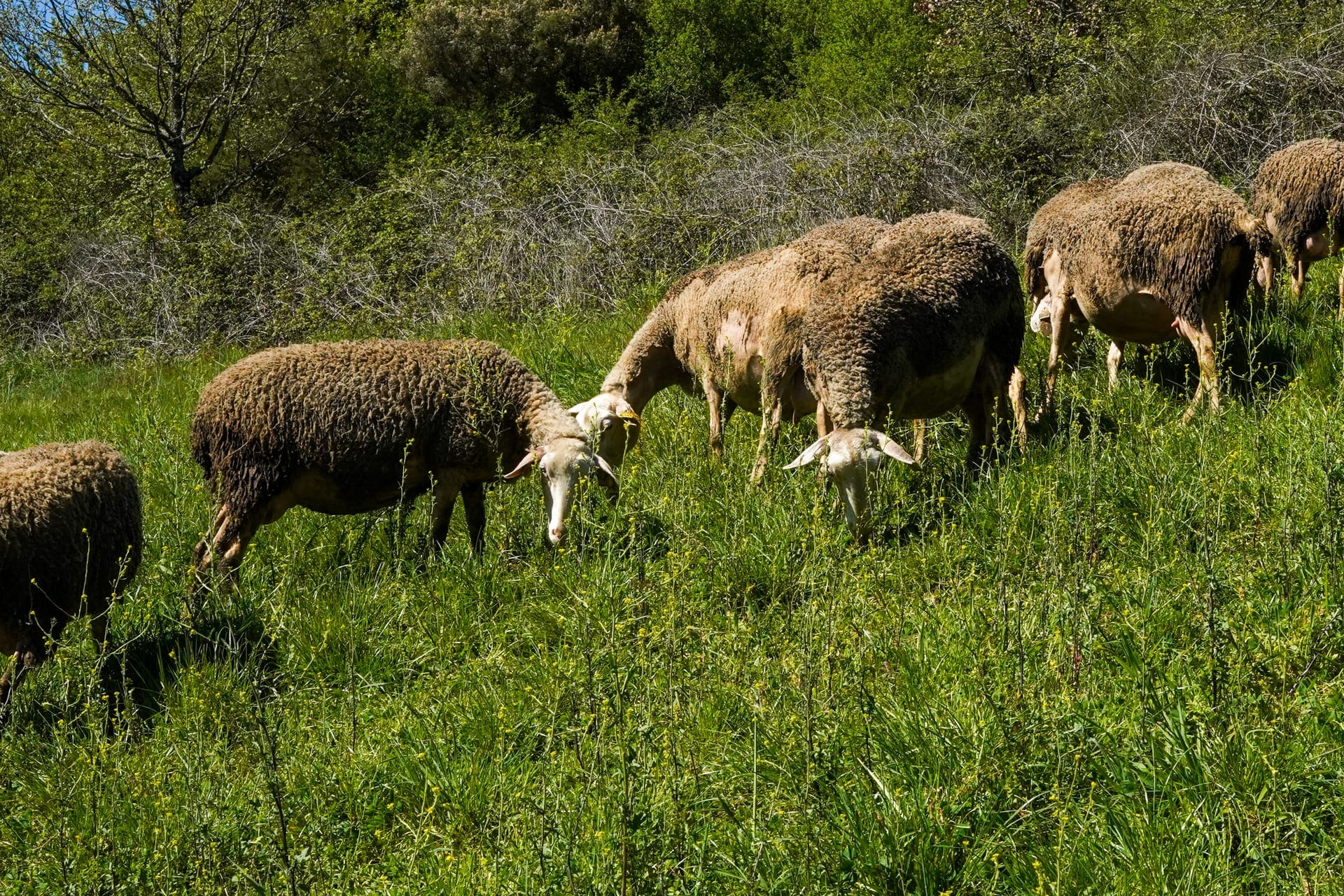
Lacaune ewes in the sheepfold, whose raw milk is used to make Roquefort AOP

Lacaune-breed ewes, the sole source of milk at Roquefort.

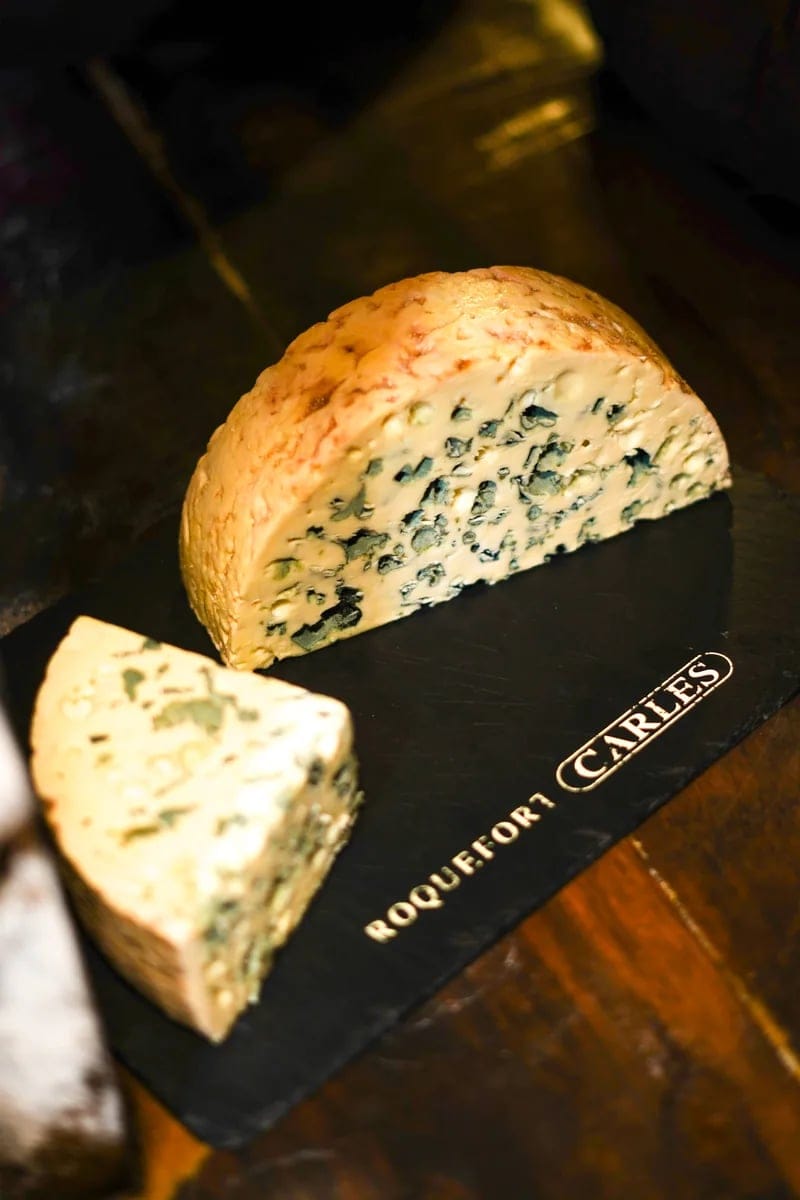
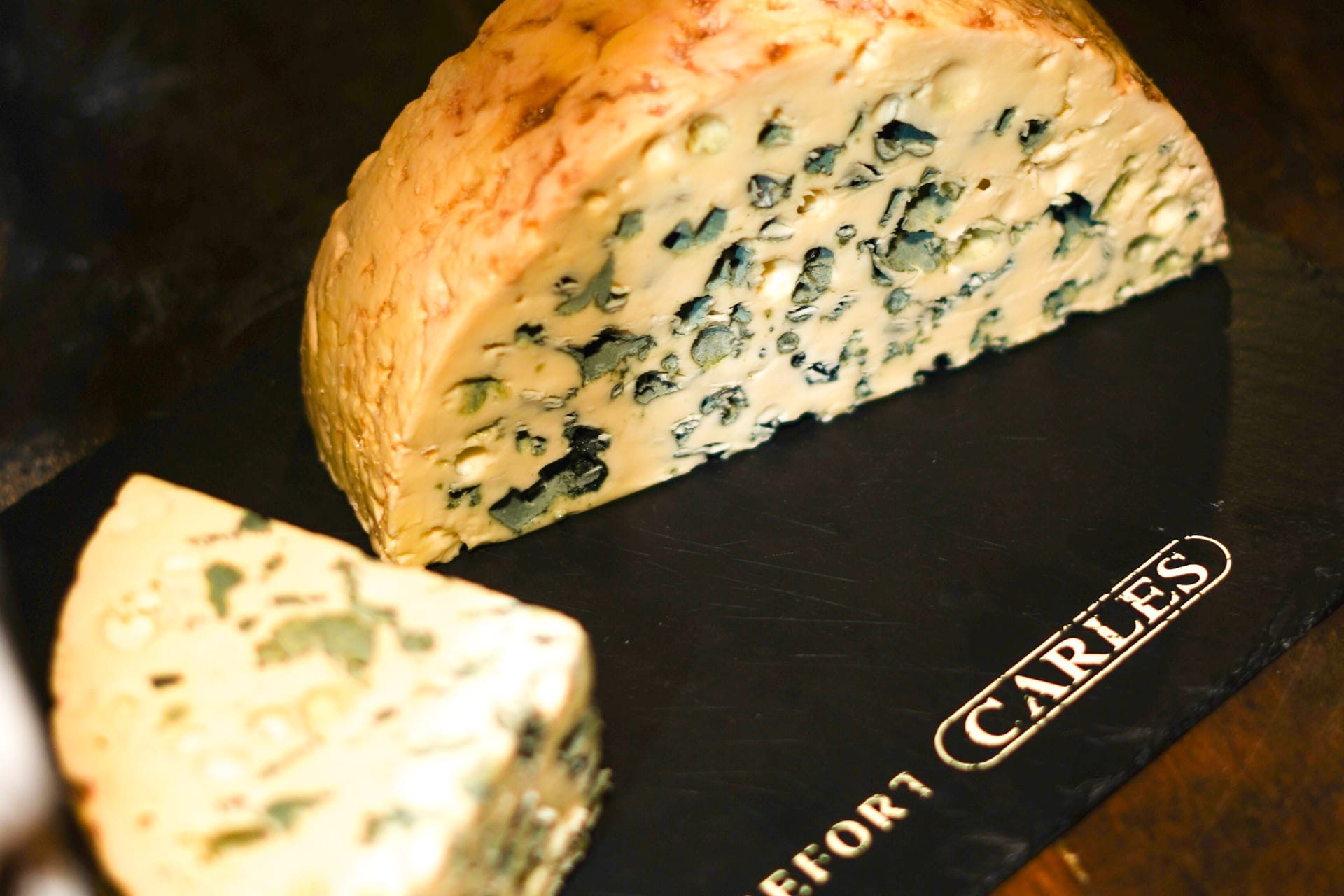
Roquefort is a French blue-veined cheese, made solely from raw sheep's milk, whose ageing takes place exclusively in the natural caves of the village of Roquefort-sur-Soulzon, in the Aveyron.

Known for its blue-green veining and its powerful character, it belongs to the family of blue-veined cheeses. Its typicity is not a matter of appearance alone: it is built within a very restricted geographical area, in caves carved by nature and under one of the most demanding AOP specifications in French gastronomy.

Unlike industrial blues, true Roquefort cannot be made just anywhere. The milk, the microflora, the cave and the human hand all take part in a single gesture, handed down over centuries. This rootedness explains why, when you seek to understand what Roquefort is, you also speak of landscape, of farming and of heritage.

Its reputation as the finest French blue rests on this unique combination: raw sheep’s milk, a natural cave and house-grown Penicillium. To take the comparison further, discover our comparison with Bleu d’Auvergne or our overview of international blue cheeses.

To learn more about the maison that carries this tradition, you can discover our family history and the meaning of the Chaperon Rouge, emblem of Maison Carles.

  • 1927Year Maison Carles was founded
  • 3Generations of affineurs in the same cave
  • 13Partner farms delivering the day's milk
Roquefort is not merely a cheese:
it is a landscape, a cave and a hand that works it.
Maison Carles, Roquefort-sur-Soulzon

Chapter II

The terroir,
cradle of Roquefort

§ 02 · IIOrigin

To truly answer the question of what Roquefort is, you have to begin with the place: a village of the Aveyron set at the foot of a scree rock called the Combalou. It is beneath this rock that the cheese’s secret lies. This unique terroir also nourished the legendary origin of the cheese, handed down since the Middle Ages.

The natural caves

The Combalou rock

A cathedral of limestone, ventilated by nature.

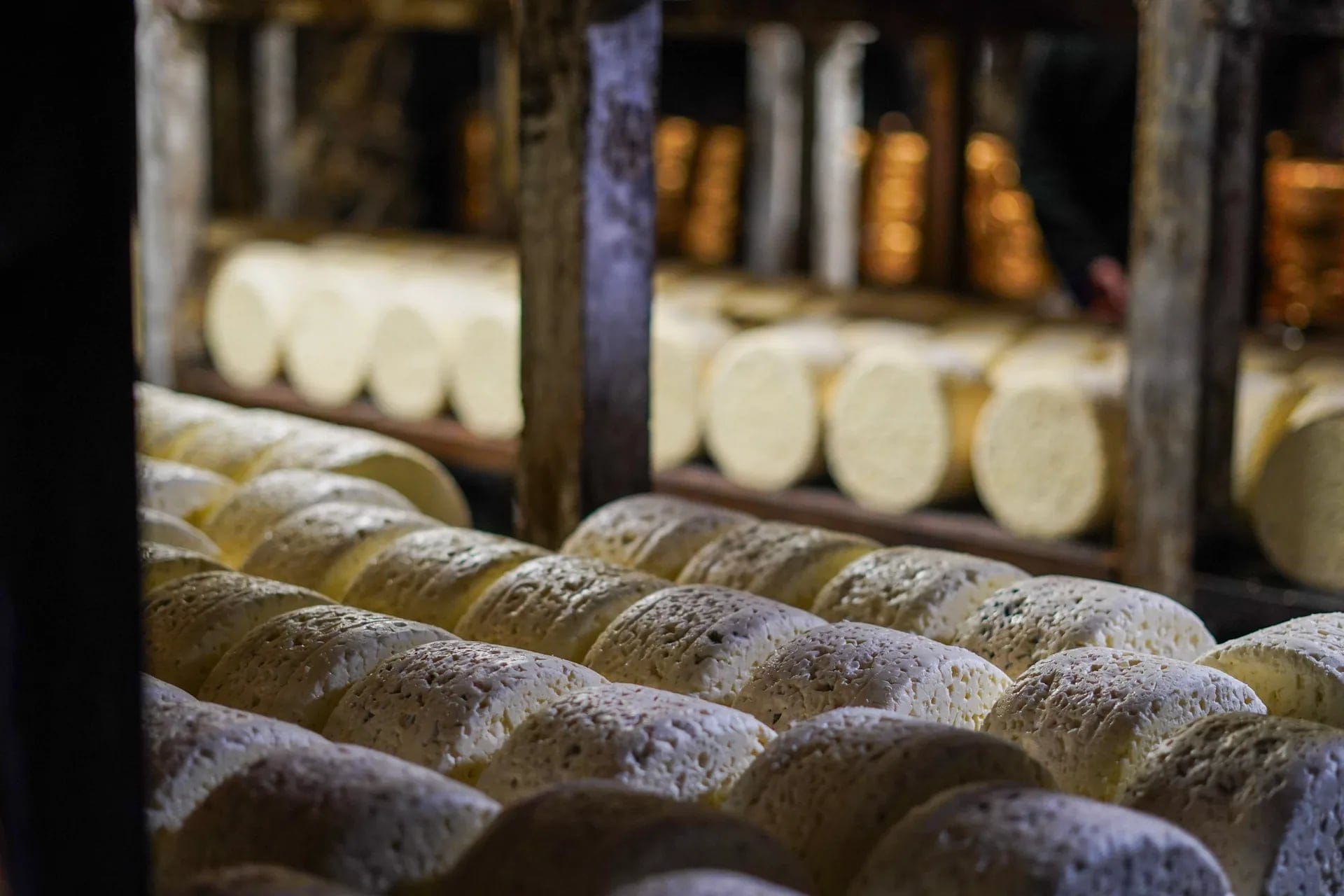
Beneath the village of Roquefort-sur-Soulzon, the Combalou rock is crossed by narrow fissures called fleurines. These natural corridors circulate cool, humid air through the caves, creating a constant microclimate all year round. It is in this environment, and nowhere else, that Roquefort can reach its full aromatic dimension.

The humidity, the coolness and the thermal stability of the caves allow Penicillium roqueforti to develop within the paste of the cheese and to draw the blue-green veining that forms its visual signature. Do you wonder why this blue colour is so distinctive? It is all explained by the chemistry of the fungus and the natural ventilation of the fleurines.

The sheep’s milk

The flocks of the Larzac

Raw milk, delivered fresh from every day’s milking.

Roquefort is made exclusively from the raw milk of Lacaune-breed sheep. These flocks graze on the causses of the Larzac and the Aveyron, limestone plateaux with aromatic grasses that give the milk its particular richness. The milk is neither pasteurised nor thermised, which preserves its natural flora and its complexity.

At Carles, 13 partner farms deliver the day’s milk to the family cave. This closeness guarantees exemplary freshness and direct control over the quality of the milk, an essential condition for a Roquefort of character.

Chapter III

The Roquefort AOP,
a strict set of specifications

§ 03 · IIIProtection

The fruit of more than a thousand years of history, Roquefort was the very first French cheese to receive an Appellation of Origin, as early as 1925. Today protected as an AOP at European level, it answers to a specification that governs the origin of the milk, the ageing area and every gesture of production.

What the AOP requires

A verified origin

Every loaf of Roquefort answers to precise rules, from the sheepfold to the ageing cave.

The milk

Raw Lacaune sheep’s milk

  • Raw milk
  • Lacaune sheep
  • Collection area

Only raw sheep’s milk, from flocks within the Roquefort collection area, may go into the cheese.

The ageing

Natural caves of the Combalou

  • Roquefort-sur-Soulzon
  • Fleurines
  • Microclimate

Ageing must take place in the caves dug beneath the village.

The Penicillium

Penicillium roqueforti

  • Natural strain
  • Blue veining
  • Aromatic

It is this fungus that draws the blue-green marbling so characteristic of Roquefort.

The Carles savoir-faire

An artisanal reading

Within the AOP, each maison defends its own interpretation. Ours favours the manual gesture and the long span of time.

The bread

House-cultivated Penicillium

  • Amandine
  • Maxime
  • House strains

Our Amandine and Maxime strains are cultivated on bread in the family cave.

The wooden boards

Oak wood

  • Boards
  • Travées
  • Long ageing

The loaves rest on oak boards, in keeping with tradition.

The hand

Manual work

  • Artisan gesture
  • 3 generations
  • 1927

Every loaf is worked by hand, since 1927 and across three generations of affineurs.

Chapter IV

From the milking
to the ageing cave

§ 04 · IVProduction

Roquefort is also defined by how it is made. To understand what Roquefort is, is to follow the path of the milk, from the ewe's udder to the oak boards in the family cave.

Step by step

From milk to curd

Collection
Raw sheep's milk delivered the same day, from 13 partner farms.
Renneting
The milk is inoculated with house Penicillium roqueforti, then coagulated.
Moulding
The curd is moulded by hand to form the loaves.
Salting
Each loaf is salted by hand, a condition for preservation.

Step by step

From cave to tasting

Piercing
The loaves are pierced to let air in and awaken the Penicillium.
Ageing
Resting on oak boards in the Combalou caves.
Care
Regular inspection of each loaf by the Carles affineurs.
Packaging
Protective packaging before going to market or direct sale.

This journey, unchanged in principle for three generations at Carles,
transforms a living material, milk, into a cheese of heritage.

Chapter V

Two ranges,
two ways to love Roquefort

§ 05 · VDiscovery

Roquefort is not a monolithic cheese. Depending on the length of ageing and the desired profile, it can prove more traditional and full-bodied, or on the contrary more approachable and melting. Maison Carles offers two ranges to explore these two faces.

Traditional reference

Convoitise range

Roquefort as we’ve always loved it.

The Convoitise range embodies traditional Roquefort par excellence: a forthright structure, a powerful palate and well-defined veining. It is aimed at enthusiasts seeking the cheese’s most characterful expression.

Accessible premium

Élégance range

A gentler Roquefort, without renouncing any of its character.

The Élégance range offers a more melting and nuanced reading of Roquefort. Ideal for introducing the cheese to new palates, it keeps the aromatic complexity of the house Penicillium roqueforti, in a silkier profile.

Chapter VI

To go further
on Roquefort

§ 06 · VIResources

Now that the question of what Roquefort is has been cleared up, several doors open to explore the subject further as you wish: history, tasting, ageing or a direct discovery at the boutique.

Chapter VII

Frequently asked questions
about Roquefort

§ 07 · VIIFAQ

What exactly is Roquefort?

Roquefort is a French blue-veined cheese made exclusively from raw sheep's milk. It is distinguished by its blue-green veining, produced by Penicillium roqueforti, and by its ageing in the natural caves of the village of Roquefort-sur-Soulzon, in the Aveyron. It is the oldest French cheese protected by an Appellation of Origin.

Why is Roquefort an AOP cheese?

Roquefort holds a Protected Designation of Origin because every stage of its production is strictly regulated and tied to a unique territory. The milk must come from Lacaune-breed sheep raised within the Roquefort collection area, and ageing can take place only in the natural caves dug beneath the Combalou rock. This AOP guarantees the origin, the craftsmanship and the typicity of the cheese.

What is the difference between Roquefort and other blue cheeses?

The essential difference lies in the milk and the place of ageing. Unlike cow's-milk blues such as Bleu d'Auvergne or Gorgonzola, Roquefort is made solely from raw sheep's milk. It is also the only one to ripen in the fleurines, those natural fissures that run through the Combalou rock and create a microclimate unique in the world.

How can you recognise a genuine artisanal Roquefort?

An artisanal Roquefort can be recognised by its raw sheep's milk, an original Penicillium roqueforti and ageing carried out by hand on oak boards in the Combalou caves. At Roquefort Carles, a family maison founded in 1927, the Penicillium is cultivated on bread in the cave itself, with the Amandine and Maxime strains, and the cheese is worked by hand by three generations of affineurs.

What does Roquefort taste like?

Roquefort offers a powerful balance between the richness of the sheep's milk, the saltiness of the ageing and the sharp note of Penicillium roqueforti. Its texture is creamy, sometimes crumbly, and its ivory paste is shot through with blue-green veining. The profiles vary by range: Convoitise is more traditional and full-bodied, Élégance softer and more approachable.

Where can you buy a quality Roquefort?

The finest Roquefort is found directly at the ageing houses established in Roquefort-sur-Soulzon. The Maison Carles boutique, at 6 avenue de Lauras, lets you buy straight from the producer, and online ordering ensures the cheese is delivered with packaging suited to the cold chain.

Taste to understand

Taste the artisanal Roquefort of Maison Carles

The best way to grasp what Roquefort is, is still to taste one. Order our farmhouse raw-milk Roquefort online, or come and meet us at the boutique at 6 avenue de Lauras, in Roquefort-sur-Soulzon.